
"Sekhmet the Eye of Ra"/ November 2014

"Sekhmet the Eye of Ra"/ November 2014 / Extra fine watercolor, 22 karat gold, lapis lazuli, Austrian crystal
Showing posts with label Egyptian Goddess. Show all posts
Showing posts with label Egyptian Goddess. Show all posts
Monday, November 2, 2015

Friday, October 9, 2015
Photo Essay: The Sacred West Triptych (Part 2)
 |
| The completed under drawing of "Auset-Weret-Hekauw" (Isis Who is Great of Magic or Enchantments)~ An original Kemetic icon by master iconographer Ptahmassu Nofra-Uaa/ with finished bas-reliefs prepared for gilding with 22k gold leaf / Panel 3 of The Sacred West Triptych |
Great Mother Auset, I receive the milk of Your heavenly breast;
The grace of the Sun reborn in the East,
The doors of heaven thrown open
For the passage of my feet.
I am Your son, O Goddess of the Gods,
Mother of the Hawk Who encircles
The two horizons.
I am suckled by You, reared through
Your greatness, as was the Lord of the Sky
When He appeared with dappled plumage
From Your womb.
I take the magic of Your breast,
Nurse from the enchantments springing
Forth from Your loins;
This is the gap from which the sun is reborn,
And I am hailed as its face in the dawn
Between Your thighs.
O Goddess, the two horizons of the sky
Become Your diadems!
Auset Great of Magic, You are the Mother
Of the God, and of all the primordial Gods
Who came into being through You.
Homage to You O Auset Weret Hekauw.
Your magic is my magic,
And through You have I come forth again
As king of the celestial dawn.
~ Invocation to Auset Great of Magic by Ptahmassu Nofra-Uaa
Part of my goal when I began my journey as a Kemetic iconographer was to bring through and honor aspects of the Netjeru (Gods) that are not otherwise receiving so much veneration or attention in the pop culture or polytheist/ Pagan communities. There will always be certain deities who will be popularly represented: Auset (Isis), Anpu (Anubis), Djehuty (Thoth), Heru (Horus)...what I call the "rock stars" of the Kemetic pantheon. These deities have no shortage of images- ancient and contemporary- to honor Them. Their PR machines, it would seem, have served them only too well.
However, even within the most celebrated deities, there are aspects of their iconography or manifestations that remain less represented, which I feel are equally as worthy of representation. My aim has been, even when creating icons for the most well-known deities, to choose modes of representation for them that call forth the lesser known aspects of their personalities. There are forms and epithets of each deity that remain obscure or in the background, or that seem to be not as forthcoming in the popular consciousness.
With the Sacred West Triptych I have chosen to celebrate three deities whose names and forms are certainly known and well represented within the ancient traditions of Kemetic iconography, but whose presence seems not to be so well established in the contemporary iconography. Ptah-Sokar-Ausir, Anpu neb Ta-djoser, and Auset-Weret-Hekhauw form the three panels of the Sacred West Tryptic. They were chosen to be placed together in this manner because these three Netjeru (Gods) are the custodians of the magic through which the blessed dead are transformed into the eternally living. Each of these Gods, in their own right, is the possessor of the Heka (or Magic) that makes resurrection and immortality possible. They are the givers of this gift, each of them taking one or more aspects of this process within their sphere of influence.
 |
| "Ptah-Sokar-Ausir"/ Panel 1 |
 |
| "Anpu neb Ta-Djoser"/ Panel 2 |
 |
| "Auset-Weret-Hekauw"/ Panel 3 |
One certainly cannot say that Auset or Isis, greatest of goddesses, lacks representation either in ancient or modern times! In particular, Auset as a goddess of magic is soundly present in the hearts and minds of all who know of Her. However, my feeling was that Auset the Great Enchantress, Isis Who is Great of Magic, in Her cobra-bodied form as nourisher and life-giver, is far less represented than in Her more obviously motherly, fully human iconography. When I prayed to the Goddess and asked Her for an image, this was the one She responded with. It is an image that summons all the magical force and motherly potency of which the Goddess Auset is capable, which surrounds, sustains and protects, just as it begets, transforms and bestows with renewed life.


The cobra Goddess Weret-Hekauw has always been a goddess in Her own right, embodying in very ancient times the kingdom of Lower Egypt and the magical power of its Red Crown. When this goddess passes into the body of Auset, the two great goddesses become an even greater goddess of indomitable strength- a goddess who contains the magic of creation and resurrection in the streams of milk passing from Her breasts.
My icon "Auset-Weret-Hekauw" celebrates a goddess who stands at the doorway to the Other World as the bearer of everlasting life for those worthy souls passing through. As She did for Her son Heru (or Horus), Auset-Weret-Hekauw stands as guardian in the marshes of the dark world, where the potentiality for chaos exists. It is Auset in Her great magic who takes hold of this chaotic potential and harnesses its power for creation, resurrection, and order. She takes all poisonous and noxious creatures unto Herself, and through Her unique qualities as magical Mother, transforms potentially deadly forces into a force that sustains and empowers the lives it touches.
Here we have a Goddess who becomes Mother to both living and dead. For the living, She is a goddess of magical protection, taking the sick, afflicted, weak or dispossessed into Her divine care. No living soul is without merit or hope in the eyes of this all-powerful goddess, Who beholds all beings as Her very own children, hearing their prayers for healing or deliverance from oppression. Her magic surrounds them all, and there is no illness, no injustice beyond the scope of Her magical embrace.
For the dead, Auset-Weret-Hekauw becomes a new mother, a womb that receives the infant seed of the soul, and bestows upon it the magic of rebirth. She suckles the souls of the newly dead, transferring unto them the divine power needed to make a safe transition between the worlds of the living and the spiritual domain inhabited by the dead.


Thursday, September 24, 2015
Woman Be Proud: Brief Thoughts on "Hwt-Her Mistress of the Sky"
 |
| "Hwt-Her-Mistress of the Sky"~ An original Kemetic icon by Ptahmassu Nofra-Uaa Extra fine watercolor, gold, semi-precious stones on 8"x10" archival panel
Genuine mineral pigments used as watercolor:
|
I am rarely "political" concerning the work I do as an iconographer. I stay within the realm of the religious, cultural and symbolic meanings behind the sacred images I construct. However, before I let too much time go by, and these thoughts slip away, I wanted to communicate feelings I had as I was asking the Goddess Hwt-Her (Hathor) to send me Her image for this icon.
My vision of the Great Goddess Hwt-Her, Mistress of the Sky and Eye of Ra, began with a desire to convey the dignity and sacredness of women as experienced within the ancient Egyptian culture. Ancient Egypt was unique in its treatment of women, granting them legal and social rights, and a highly significant role in the sphere of religious practice. What people today call the Sacred Feminine was omnipresent in the pantheon and religious rites of the Egyptian state. Women were vital, they embodied the Gods...they were the mothers of Gods!

Hwt-Her embodies the sacred power of female sexuality, motherhood, love, the dance, the union of couples, the production of offspring, the glories of love. Lust too is celebrated within the cult of Hwt-Her, as is sexual ecstasy and sacred intoxication. Hwt-Her is not aligned with prudery or sobriety. She is not meek. She is not demure. She is not beneath the thumb of any man! She stands proudly as the Mistress of the Sky, a radiant vision of Goddess as WOMAN, WOMAN as GODDESS.
I couldn't help but feel- as I meditated on what I wished to achieve with this icon- that the situation in many parts of the Middle East, and indeed the world over, is far from matching the sacredness and freedom the ancient Egyptians gave to their women. How often are women marginalized, silenced, locked away beneath the guise of "tradition", and, even worse, stripped of their dignity and humanity, forced to live as less than second class citizens.
We teach our young women to "dress appropriately", otherwise they are "asking for it". Women are often treated as the instigators of violent sex crimes instead of as victims, and they are re-victimized. The bodies of women are censored...the breast and nipple are such a threat to public decency that they should not appear. Of course, men are much more free to let it hang and to be seen in all their glory.

When I composed the form of the Goddess Hwt-Her based upon a dream She had sent me, I consciously chose to represent Her as a WOMAN awake in Her sexuality and femininity, a Goddess and a Queen Who takes upon Herself the role of leading women into a higher state of awareness of their ultimate power- not only in the human world, but in creation as a totality. Women are the way we enter this world, and it is through them that we are nurtured, loved, brought into manhood (if we are men), and given the seeds of eternal life. It is through Goddesses such as Hwt-Her (Hathor) that a man is initiated into the Mysteries of birth and rebirth. His sexuality is Hers to give, and She is the heavenly vessel that embraces his earthly seed, allowing it to mature into Deity.
My icon of Hwt-Her depicts WOMAN UNVEILED. She will not be contained by man's fear of female sexuality, nor by fundamentalism's mandate that it was through woman that sin first entered the world. Women have been and are imprisoned, tortured, and murdered on the basis of this insane philosophy alone. Young women are sexually mutilated, and violent repression, social and political, is used to cover women and keep them "in their place".
My icon of Hwt-Her is my way of demonstrating against these atrocities, and at the same time giving a Goddess I adore a cult object suitable for Her worship. It is an act of love and pride in WOMANKIND, to hail the presence of the Sacred Feminine from which all living things come forth. It is a statement embodying the DIGNITY, BEAUTY and NOBILITY of WOMEN as the keepers of man's heritage and destiny. She is our Sky, our Womb, the vessel of our rebirth. How can we cover Her, shame Her, keep Her hidden? We can't. WOMAN will continue to rise, and to challenge any notion that She can be anything less than DIVINE.

Tuesday, August 11, 2015
Photo Essay: A Dazzling Goddess/ Hwt-Her Mistress of the Sky
 |
| "Hwt-Her-Mistress of the Sky"~ An original Kemetic icon by Ptahmassu Nofra-Uaa Extra fine watercolor, gold, semi-precious stones on 8"x10" archival panel
Genuine mineral pigments used as watercolor:
|
Archival prints of "Hwt-Her Mistress of the Sky" are now available at FineArtBistro.
ALL photos presented here are courtesy of Hunter Howatt of Pixels & Ink
 |
| Master iconographer Ptahmassu Nofra-Uaa holds his latest masterpiece "Hwt-Her Mistress of the Sky" |


Tuesday, June 9, 2015
From the Archives: Sekhmet Revisited
 |
| "SEKHMET THE EYE OF RA" Extra fine watercolor & 22 karat gold on 8" x 10" archival panel (SOLD). ORDER A MUSEUM QUALITY ARCHIVAL PRINT Genuine mineral pigments used as watercolor: Lapis lazuli (Chile), amethyst (Soladad, Brazil), jadeite (Alaska, USA), Mayan blue (Texas, USA), bloodstone (Alaska, USA), rhodonite (Bellahorizonte, Brazil) piemontite (Alaska, USA). Cabochon gemstones: Lapis lazuli (Afghanistan). Austrian crystal elements by Swarovski® |
Note: Earlier this year I was interviewed by celebrated poet and author Adriano Bulla, during which I was given the opportunity to discuss all aspects of my work in depth, and in particular the various layers of symbolism present in my works as an iconographer. My icon of the Goddess Sekhmet, "Sekhmet the Eye of Ra", was a primary example I used in this discussion to highlight how my Kemetic icons function, symbolically and spatially, and I would like to present here those portions of our dialogue in which this work took center stage. To date, "Sekhmet the Eye of Ra" remains the work in which people express the most interest, so I feel it is of value to extract my comments from my interview with Adriano Bulla and offer them here as part of the record of how this unique icon represents the Great Goddess.
In "Sekhmet the Eye of Ra" I used a large quantity of lapis...oh, I'd say
probably the most lapis I've used in any icon to date...because the
Goddess Sekhmet is the daughter of the Sun-God, Ra, and all solar
images, images that reference Ra or draw on His mythos, inevitably
include lapis lazuli, the sacred stone associated most with the Sun-God.
As the Eye of Ra, the visible and terrible power of Ra, Sekhmet too is
associated with gold and lapis lazuli. The tips of the feathers in
Sekhmet's wings are all lapis...the falcon feathers in Her corset and
kilt are lapis, together with the sporran and belt. All the jewellery
has lapis in it, and of course the Wedjat Eye in the flaming sun on top
of Her head. There's lapis all over the place in that icon! The border
framing the inner panel of the Goddess is composed entirely of lapis
lazuli, with some real amethyst mixed in to arrive at the darker shades.

Both
space and direction play significant roles in all my icons. In the
Kemetic, ancient Egyptian approach, left corresponds to east while right
corresponds to west; so, in "Sekhmet the Eye of Ra" the Goddess sweeps
in from the east as the representative of the Sun-God, and dispatches
the serpent-demon Apep to the west. The west, the land where the sun
sets and is swallowed up by the Sky Goddess Nuit, is symbolically the
land of the dead. This is the direction where the dead are sent in order
to undergo the metamorphosis from mortal to immortal. The west is
always symbolic of the sacrifice the Sun-God makes each night when He is
consumed by darkness, in order to be reborn in the east the following
morning.
"Sekhmet the Eye of Ra" presents us with one of the key episodes in the
solar mythos. Sekhmet is known from a sacred drama as a enraged, fire
breathing and bloodthirsty lioness, whose terror is unleashed on the
enemies of the Sun-God. This is the episode being illustrated here;
however, we also have a reference being made to the theology of Annu or
Heliopolis which states that at dawn, Ra as the Great Tomcat slays the
serpent-demon Apep with His knife beneath the sacred persea tree, the Ished.
The Ished has not been included in my icon for space considerations,
but the Goddess here is certainly the very embodiment of the destructive
power of the Sun-God Ra, whose flaming Wedjat Eye She carries in the
sun disk upon Her head.
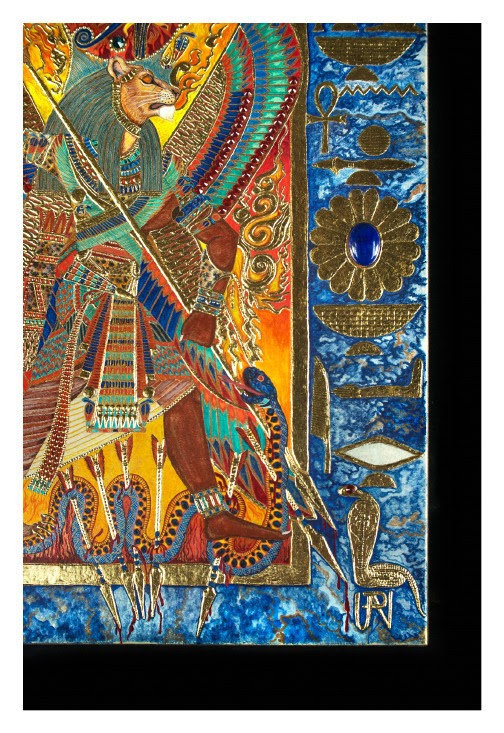
Sekhmet is here an embodiment of the eastern direction by virtue of Her being depicted facing the western or right side of the panel. She also carries the sun on Her head, which insinuates the rising sun. We know it's the rising sun, the eastern sun, because the time of day when Ra slays Apep beneath the Ished Tree is precisely at sunrise. So, here we have Sekhmet, the newly birthed eastern sun, sending Apep into the darkness of the west.
But the entire thrust of this icon is obviously moving towards the
right side of the panel, which of course is intentional for the reasons I
just described. I've also 'cheated' on the proportions of Sekhmet's
anatomy in order to make Her right side appear larger than the left. Her
right leg is definitely longer and larger, which makes Her appear to be
stepping out of the canvas in order to pin down the coils of the
serpent. Her right arm is also grasping the golden lance with the fist
pointed downward, which means toward the west...toward the direction of
Apep's impending doom. Her downward turned arm directs the eye quite
naturally to the direction of the action, which is the lance being
thrust by the Goddess into the neck of the serpent-demon. A downward
turned fist in this instance is also a magical reinforcement of the
action of dispatching Apep and gaining control over his wild power.
Sekhmet has him in hand, as it were.
Quite
subtly, the lower right wing follows the precise line of the golden
lance, and appears to be bursting through the neck of Apep as well. The
direction of the wing in this case too is magical. It's part of the
anatomy of the Goddess crossing over into the space being held by the
serpent-demon. Her power and authority is obviously overtaking his. Her
magic is subduing him.

The fire-capped lance of the Goddess is the largest directional line in
the composition...it moves the eye very naturally downward, to the
bottom right corner of the icon panel. This directional line, the golden
lance or spear, embodies the destructive power of the Goddess, which of
course is one of the primary magical themes of the icon. The Goddess
has the power to control and destroy the ability of chaos as it attempts
to undo the work of creation. She is the fire of the Sun-God's Wedjat
Eye, His representative, His swift justice.

There are some very subtle directional lines placed in this icon. In
the lapis lazuli border at the top of the panel, I have painted a little
lightning bolt like squiggle, which comes from the very outer edge of
the icon and touches the fire shooting out from the pommel of the lance.
This leads the eye, then, down right across the composition and to the
bottom right corner of the panel, where the point of the spear juts out
from the pierced neck of the serpent-demon Apep. Notice the tiny streams
of blood pouring down from the lance tip, which meet one of the seven
arrows piercing Apep's neck. This also has a stream of blood dripping
down from its tip, which takes the eye down to the bottom of the panel.
Both spear tip and arrowhead point at the rearing solar cobra with its
angrily extended hood. This is the fire-spitting cobra that sits on the
forehead of the Sun-God Ra, and magically, in this context, the presence
of the cobra acts as a bookend to the body of the Goddess, closing in
the negativity of the serpent Apep from both sides.
Space, both positive and negative, are always important considerations
in any icon. Of course, as a general rule of thumb, the deity must
always take up the largest amount of space in the icon panel. My icons
have two major space components or divisions. The first is what I call
the 'outer panel'. This is the border framing in the deity. The two side
portions of this outer panel are usually reserved for the hieroglyphs
containing the names and epithets of the deity depicted. These are
appropriately placed with each of the hieroglyphs facing inward towards
the deity, as is natural in the traditional use of Egyptian hieroglyphs.
Then we have what I call the 'deity house', that is to say, the inner
panel where the deity's image is actually painted. Because each deity is
different in terms of their anatomy and the size of their crowns or
accoutrements, the amount of positive and negative space in each icon
changes. In "Sekhmet the Eye of Ra" my challenge was to fill the inner
panel with as much of the Goddess as possible, to reinforce the sense of
Her awesome power pouring out of the icon...shooting out like fire, in
an almost uncontrollable manner.
The
large X created by the Goddess' wings was of central importance to me
in the initial stages of production. It was the guiding factor as I
blocked in the other proportions of Sekhmet...how these would consume
space to the left and right of the panel. This consumption of space is
very much magical; as in the more space taken up by the deity, the
greater Her power and magic. The negative space in the top portion of
the X created by the wings actually frames in Sekhmet's head, providing a
pair of directional lines that move the eye into the body of the
Goddess. The fiery energy of the Goddess moves downward with the
directional lines provided by Her bottom pair of wings; however, this
energy flares upward in the form of dancing and curling, spiraling
flames. These flames take up almost all the negative space in the icon,
and their direction leads the eye upward into the sky, the dwelling
place of the great Eye of Ra.
Everything I do in my icons serves a magical and symbolic purpose.
Absolutely nothing in these sacred compositions is purely ornamental or
arbitrary.
Wednesday, June 3, 2015
Photo Essay: A Goddess, From Start to Finish
 |
| "Hwt-Her Mistress of the Sky"~ An original Kemetic icon by Master Iconographer Ptahmassu Nofra-Uaa/ 8" x 10" archival panel. Genuine mineral pigments used as watercolor: Lapis lazuli (sourced from Chile), Amethyst (Soladad, Brazil), Bloodstone (Alaska, USA), Jadeite (Alaska, USA), Piemontite (Alaska, USA), Rhodonite (Bellahorizonte, Brazil). Hydrated iron oxide (red and yellow ochre) 22 karat gold, turquoise (Tibet), Shattuckite (from the Shattuck Mine in Bisbee, Arizon) with malachite, Austrian crystal elements by Swarovski Company |
Homage to You, Hwt-Her, Lady of Life,
Enveloped in turquoise with the lotus
as your diadem!
O Golden Lady, how can men approach you?
How can the Gods behold your glory,
shining as electrum in the Eastern heaven.
To look upon You is to be blinded
by the fire of your body, casting the
shadow of the Sun as that Great Cobra Goddess.
The Sun's light does not reveal your completeness,
Though your embodiment is the circuit of the
Wedjat Eye in its time;
it is unknowable, and the Gods cannot fathom
your strides across the Imperishable Stars.
O Goddess, the Mistress of the Sky,
how fair is your countenance,
how dazzling your lips,
your eyes of green malachite,
your eyebrows like the iridescent plumage
of the Sacred Falcon.
How He comes to you, erect upon His perch,
His lofty standard shining with your love.
He embraces you, the One of the Two Horizons,
His two wings not spanning the length of your
divine body.
Smitten, the Lord of Valor becomes yours,
as you, the long-legged Goddess, cause the
faces of the Gods to be turned away,
Ensnared by your beauty.
Homage to You, O Lady of Love
who bestows rapture by the very sight of Her,
whose body challenges the Sun for His light,
whose Father is born through Her,
whose brother becomes the Lord of the Earth
by way of Her thighs!
You, O Hwt-Her, are the sovereign Mistress
before whom the Gods submit their powers.
Mysterious One, who in secret gives birth
to the Sun in His moment of becoming.
Let me, too, come near to You in the hour
of your rising, when in shards of turquoise
your face becomes the illumination of the
Sun-God.
May my two eyes behold You,
may my ears hear the shaking of your papyrus reeds,
may my nose inhale the intoxication of your lotus-fragrance,
and may I be one of those in your entourage
who lives forever on account of You.
- From the Hymns of Hwt-Her Mistress of the Sky
By Master Iconographer Ptahmassu Nofra-Uaa
The creation of an icon (at least my creation of my icons) is a long and involved process requiring a number of steps, not least of all is that which cannot be properly represented by photographs, namely the cultic offerings, devotional prayers, and ritual acts through which a small, flat panel of wood becomes a living incarnation of a deity. There is much more to the production of an icon than the layering of paint and application of gold and other precious substances. If that was all that were required, I should think that anyone with reasonable artistic skill could paint an icon and call themselves an iconographer. But such is not the case, in my opinion, for in my many years of study and practical application (oh, 35 or so years at this point) I have learned the truth that icon painting is an intimate collaboration between the artisan and the deity.
An iconographer is called upon to establish a direct link or dialogue with a deity, and it is through this exchange, requiring both faith and devotion, that a two dimensional work receives the divine spark of life, acquiring the power to manifest the presence of the deity represented by it. Without such an interdependent relationship, a true icon cannot come into being. This is literally a magical process, during which the iconographer, as priest/ priestess and servant of the deity, opens or awakens the image to an interior divine life that separates it from the inanimate, and makes of it a living image suitable for cultic service.
Of course, each iconographic tradition deserves to speak for itself, and each will naturally have its own language in the carrying out of its visual duties; therefore, I can only speak for my own tradition, which is that of Kemetic Iconography. Thus my comments here must be read as coming from that vantage and not from any other. I do not speak for the Russian Orthodox iconographic tradition, nor the Greek, nor the Buddhist, or the Hindu. I am a Kemetic, a practitioner of the original and ancient faith of Egypt (Kemet, hence Kemetic). Thus my comprehension and practice of the art of iconography stems from a theological vantage that often differs quite substantially from other schools of iconography, and here I am thinking of those of the Christian persuasion. Kemetic iconography, as I understand and practice it, has much more in common with Hindu and Buddhist iconography than it ever will with the Greek or Russian Orthodox traditions.
My Kemetic icons begin with a petition to the netjer (or deity) intended for representation, which is presented in the form of traditional prayers and their accompanying offerings. My intention is firstly to honor the netjer, and to receive their explicit permission for using their physical likeness in the formation of a cult image (sekhem). This may seem somewhat strange to individuals not following in the footsteps of Kemetic Reconstructionism or Kemeticism, but it is known that the most fundamental stage in the consecration and awakening of any sacred image (as practiced by the ancient Egyptians)- be it a temple, wall relief or three-dimensional representation of a god- is to call forth the deity and ask them to take ownership of the image, which must be properly prepared through the ritual actions of purification and the performance of the cultic acts of Opening the Mouth(1).
I do not, of course, begin the creation of an icon by bestowing the Opening of the Mouth (or Wen Ra). That would not be appropriate at the beginning stages of a sacred image. What is vital for the initial stages of icon production is the honoring of the deity through the bestowal of the appropriate offerings and cultic prayers, which are performed as the fresh icon panel is placed on a bed of sand in the presence of an awakened cult image of the deity being so honored. An unused wick of twisted fibers is offered in a vessel of precious onyx, into which olive oil is poured and the wick set aflame, thereby creating an oil lamp signifying the initiation of creation, cosmologically and magically through the birthing of a new sacred image.
Viewers of my icons are not privy to the sacred processes through which I activate my images with divine life, or rather, engage the netjer in the process of co-creation with me. A viewer sees the completed icon, and perhaps has seen photographs of the icon in its various stages of production, but has not seen the tremendous spiritual/ ritual process that goes into the evolution of such images from beginning to end. It is easy to forget, when art lovers appreciate the visual presence of my icons, that these are in fact cult objects, highly complex ritual objects whose sole purpose is to give physical form and habitation to the manifest essence (ba) of a god or goddess. The icons I create are not intended for hanging on a wall in an art gallery or home so that they can be admired as art objects, as decorative showpieces. Such would defeat the goal and function of an icon as a vital component of cult and daily service to a living deity.
It is difficult, I think, for modern people, who are accustomed to the values and modes of modern art, to comprehend why any artisan would go to the massively time-consuming lengths of creating an intricate image from expensive and precious materials without intending it for public display and consumption. It boggles the mind, then, to see incredible works of art like the solid gold death mask of Tutankhamun, or the astonishing, vivid bas-reliefs in the royal tombs in the Valley of the Kings, and realize that these things were never intended to be seen by human eyes once they had been sealed away in the tomb. Their purpose was entirely cultic, that is, ritual and magical. These were not created as works of art to be enjoyed by mortal eyes, but strictly as pieces of magical technology through which an interior purpose could be accomplished.
Thus my icons are not created with the intention that the masses should enjoy them as art, although photographic reproductions are made available for consumption, and of course can be seen on the Internet and social media. But the originals are not available for mass consumption, as that would, again, defeat the ultimate aim of their creation. Such icons are crafted, first and foremost, as earthly bodies for living gods, and that is why so much time and energy, to say nothing of expensive and precious resources, is put into their making. Each detail, layer of precious color, leaf of pure gold, and semi-precious stone is painstakingly worked into an object of devotion and magic (heka), whose ultimate purpose is to entice the deity to enter it, and in so doing establish a permanent and vital presence within the activities of the temple cult. These icons are pieces of machinery, setting into motion a dynamic meeting place between the divine and mortal worlds. The icon, then, belongs first to the deity, and is created strictly for their use. Always, the intention behind the commission and maintenance of an icon is that the deity will choose to inhabit and utilize the image, giving worshipers ready access to forces that might otherwise be beyond the scope of our often limited human cognizance.
In celebration of the completed icon "Hwt-Her Mistress of the Sky", I would like to present my readers with this collection of photos that documents, from start to completion, the creation of this icon. In the past almost six months it has taken me to produce this cult image, I have at intervals posted pictures and essays on my progress with Hwt-Her, which are scattered between various other ramblings I have chosen to share on this blog. Now I would like to present these photographs as a collection that can, I hope, give the reader a sense of the tremendous work and technical skills required in the creation of my icons. These pictures are not a credit to myself, nor a testament to my advances as an iconographer or visual artist, but are instead a testimony of a collaborative co-creation between my heart and hands and those of the Goddess Hwt-Her. This is Her icon, not mine. It was by way of Her passionate, loving presence that this icon has come into being in our material world, for it was first created in Heaven, and we are only able to view it because the Goddess wishes it so.
Notes
1 Shafer, Byron E. Temples of Ancient Egypt. New York, 1997, pp. 7-8.
1 Shafer, Byron E. Temples of Ancient Egypt. New York, 1997, pp. 7-8.
The fresh icon panel, after ritual purification and consecration on a bed of sand,
is deposited on the Altar to receive the spiritual charge of the Goddess Hwt-Her.

A precise under drawing is completed on the icon panel. Every detail
of the sacred composition has been measured out on a grid
according to exacting standards.


Using gesso in liquid form, highly significant details of the deity composition
are slowly built up into bas-reliefs (raised reliefs). These will receive
gilding with 22 karat gold.


The bas-reliefs are now painstakingly gilded with 22 karat gold.


Using precious mineral pigments, layers of rich color and details
are built up on the icon panel.


Details of the completed icon "Hwt-Her Mistress of the Sky"


Subscribe to:
Posts (Atom)