"Sekhmet the Eye of Ra"/ November 2014

"Sekhmet the Eye of Ra"/ November 2014
"Sekhmet the Eye of Ra"/ November 2014 / Extra fine watercolor, 22 karat gold, lapis lazuli, Austrian crystal
Showing posts with label Tutankhamun. Show all posts

Monday, March 2, 2015

Photo Essay: Raising Hwt-Her (Hathor) Mistress of the Sky

Highly magnified detail from "Hwt-Her Mistress of the Sky" by master iconographer Ptahmassu Nofra-Uaa

The ancient Egyptians achieved the miraculous in the decoration of their temples and monuments, sculpting hard stone into the softest, most delicate of forms in order to breathe life into the places where gods and kings would tread.  When I say "decoration", I must be careful not to evoke the concept of art for art's sake, or ornamentation strictly for aesthetic considerations; as these concepts did not exist in ancient Egypt.  What we call decoration of Egyptian temples and monuments was in fact carefully orchestrated magical composition, images whose purpose was to actively engage in the sacred work of maintaining creation and the cosmic order.  Art works in ancient Egypt were animate creations to their makers, part of a highly ordered program of ritual activities that comprised what academics call the cult of Egyptian religion.  Cult in ancient Egyptian religion is the entire corpus of sacred activities, ranging from ritual offerings and gestures to two and three-dimensional deity images.  It was the deity image or cult image that formed the backbone of the temple system in ancient Egypt(1).

Three-dimensional cult statues made of solid gold and inlaid with lapis lazuli and other costly stones were maintained in every temple complex in Egypt, and these were the focal point of the elaborate rituals of the daily cult.  However, such images were only one type of deity image to be housed in the sacred precincts.  Still to be seen today in temples throughout Egypt, though far from the brightly painted glory of their heydays, are the astonishing range of both low and high relief carvings that covered literally every inch of these sanctuaries.  The Egyptians specialized in bas-relief, the very laborious and time-consuming technique of cutting down all the background stone of an image in order to leave it raised up slightly from the surface.  Such sculptural details were used throughout Egyptian temples to highlight important ritual images of the king as high priest performing the activities of the temple cult.
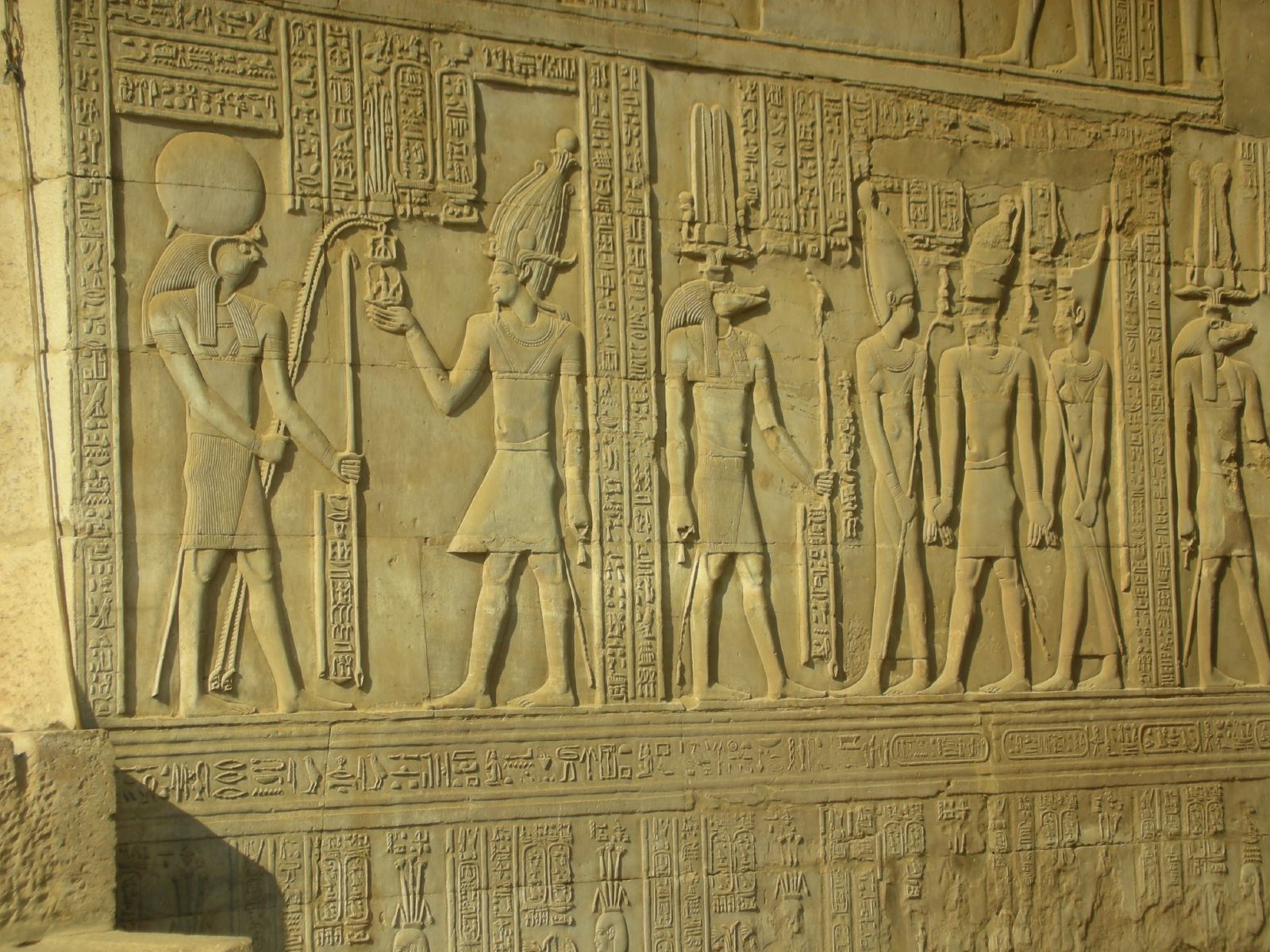

Ptolemy VIII relief, Temple of Kom Ombo, Egypt


Images of the Gods, too, were central to the elaborately sculpted and painted bas-relief programs added to magically awaken Egyptian temples, and there is plenty of evidence to show that certain of these images became focal points for cults of their own(2).  The most hallowed interior spaces of Egyptian temples were accessible only to special classes of the priesthood, however, the outermost walls of temples were places where common Egyptians could congregate in order to approach the Gods through special images carved into the stone surfaces of the temple(3).  Archaeological evidence amply supports the existence of sacred spaces for public and/ or semi-private prayer and worship that existed on the outer, public walls of Egyptian temples.  These existed in the form of relief images that were regarded as especially sacred, and were sheltered by cloth enclosures suspended from wooden dowels fitted into holes drilled into the stone around the images(4).  Some such images were even inlaid with colored and highly reflective materials in order to highlight their sacredness. Such spaces provided a semi-private means for ordinary Egyptians to give their personal petitions to the Gods.

My own work as a Kemetic iconographer strives to build a bridge between traditional and ancient avenues for worshiping the netjeru (Gods), and contemporary needs and considerations.  We no longer have the vast resources of a state-supported religious system to maintain our temple traditions, and the temples themselves have radically changed in stature.  We are groups of devotees here and there, many on the Internet, doing our very best with often considerably limited means, to carry on a millenniums-old tradition of honoring Egypt's original deities.  My strongest means of accomplishing this is through the revival of the cult image as a means for establishing an authentic energetic link with the netjeru, which forms a foundation for the practice of the daily cult.

I am obviously not working in stone, thus true bas-reliefs are not my medium.  However, I have developed my own technique for continuing the time-honored use of raised relief surfaces for sacred images of the netjeru.  Using gesso in a liquid form, I carefully build up especially significant details of my icons into 'bas-reliefs', which are then gilded with 22 karat gold.  Crowns, jewelry, hieroglyphs, and certain parts of a deity's anatomy are prime candidates for gilt relief treatment in my icons.  These portions of the icon will then stand out considerably in the shrine and ritual environment, where they will be viewed primarily by candle light.  Real gold has always been used for icons in many iconographic traditions around the world, and this because gold is not only a precious commodity, but also because of its luster when exposed to direct or indirect lighting.  This effect is significantly heightened when the thinest leaves of gold are layered over a finely detailed relief surface.


A scene from the miniature shrine found in the tomb of Tutankhamun depicting the young king with his queen Ankhesenamun

A similar effect was achieved by the artisans who crafted the miniature gold-covered shrine found in the 18th Dynasty tomb of Tutankhamun.  In this instance, craftsmen used a linen-covered plaster base in order to produce very delicate raised reliefs, which were covered in thick sheets of gold foil that were then exquisitely chased(5).  My technique may be somewhat different, but it is completely in keeping with the spirit of such ancient works recovered from the tomb of Tutankhamun.  Instead of working my details into thick sheets of gold foil, my technique uses a liquid gesso to create raised and intricately detailed surfaces to receive the thinest and finest gold leaf available.

Notes 

1) 
Teeter, Emily.  Religion and Ritual in Ancient Egypt.  New York, NY, 2011, pp. 41-46.
2)  Ibid, pp. 78-83.
3)  Ibid, pp. 83.
4)  Ibid, pp. 78.
5)  Reeves, Nicholas.  The Complete Tutankhamun: The King, the Tomb, the Royal Treasure.  New York, NY, 1990, pp. 140-141. 

I now present a collection of photographs of my icon panel of "Hwt-Her Mistress of the Sky", which show the completed gesso reliefs prior to sealing with shellac and gilding.


Tuesday, February 17, 2015

Autobiography of A Mystic (Part 1)

The artistic life is creation...the spiritual life is immortality.  What happens when we combine the two?

Author's preface

In late Fall of 2014 I was asked by the Priesthood of the Temple of Antinous Hollywood to submit an introduction of myself to the online community so that they could become better acquainted with me and my spiritual journey.  Though they had asked for a "simple", "brief" description of who I was and how I had come to my unusual spiritual calling, what I gave them was a novella of sorts, an outpouring of the major events that had shaped my journey into the Sacred from the time I was a child to the near present.  I had begun with the intention of brevity, which was, as anyone who knows me well enough can attest, a futile effort.

Something happened to me as I began to reflect on my very strange childhood, on the eccentric personalities and synchronicities that swept across my path and caused me to take up an unorthodox path.  I realized as I got deeper into this writing that though I had discussed some of these events with people very close to me, I had never spoken about, let alone written down, so many significant episodes that have shaped my life quite profoundly.

In anticipation of my birthday next week, I would like to offer up this autobiographical sketch as a means of sharing my spiritual journey with those who have an interest in my work as an iconographer and path as a Kemetic Reconstructionist/ mystic.

I was initially going to title these posts "Autobiography of a Kemetic", however, that would imply to my readers that the contents would be exclusively Kemetic (Ancient Egyptian), without the flavor of other paths or practices being part of the mix.  Though it is true that I now identify my path as Kemetic or Kemetic Reconstructionism, that has not always been the case.  Kemetic, yes.  I have served the netjeru or goddesses and gods of Ancient Egypt (Kemet) very consciously from the time I was six years old.  But serving Them from a Reconstructionist point of view is something that has evolved slowly and steadily, almost imperceptibly over the past five to six years especially.  As happens when you develop and grow in your relationship with living deities, They guide you, often in very unexpected ways, to perspectives and areas of self-investigation that had hitherto remained in the shadows.

In these regards, I share with you my reflections on the people and events that have gone into the making of the man and the artist you now see before you.  My hope is that this gives further insight into the seeds and nature of my work as a Kemetic iconographer.


Life Begins at 40/ Wonderful Things

I turned 40 last year, and I keep being reminded of that funny little saying "life begins at 40". My experience is that a lot of gay men are age conscious and have a tendency towards holding onto their youth, even long after their youth has let go of them. Aging has never bothered me, but it has made me aware of the truth of that long standing belief that with age comes wisdom...or at least with that length of experience comes insights, knowledge or epiphany. This year has been a pivotal year for me, spiritually, emotionally and metaphysically. I find that the Gods are opening up doors for me that I never knew were there, waiting patiently.

I was born a native of San Diego, California, where my father received his Master's Degree in anthropology and the humanities. He was also an artist, a very talented watercolorist and painter of male and female nudes. His focus in some of his work was the figurative art of the Greeks and Romans, which also was central to his research for his degree and studies in the arts and humanities. His den where he drew, researched and painted was full of books of antique art and ancient Mediterranean civilizations.

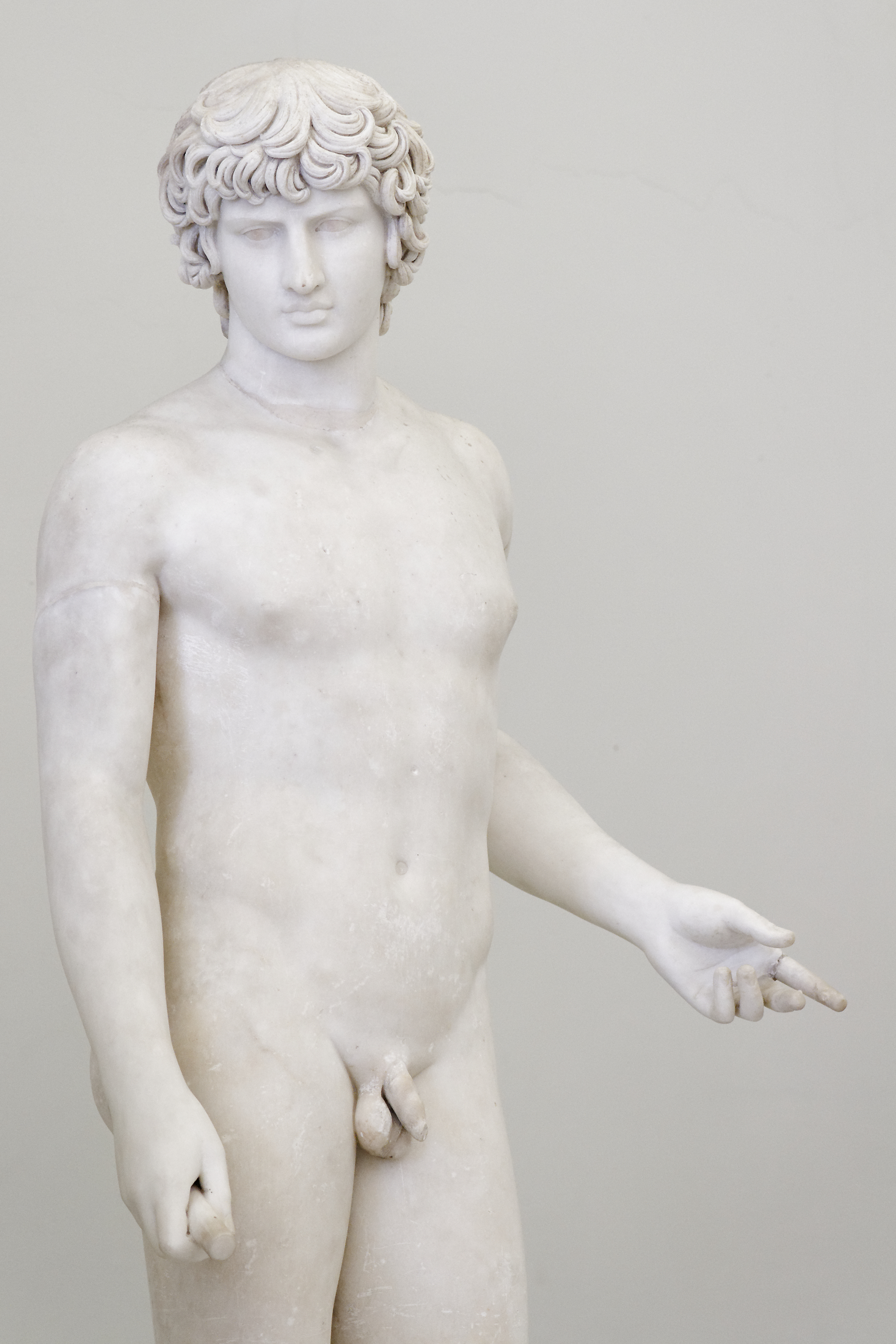
It was there in his den that I uncovered, at the age of seven or eight, the massive scholarly volumes on ancient Rome and her art. It was there that I first saw the famous Farnese Antinous...that sensual and divine exploration of the nude male form. I was hooked. Despite my very young age, even then I remember being conscious of my sexuality and my attraction to the Gods of Classical antiquity. Antinous always represented for me the promise of immortality and resurrection, agelessness and continuity of the Soul. But also, he embodied the innocence of a noble mind untainted by time or human experience. He was a representative of a quest for the Highest Nature to which humankind is the heir. Even as a boy, I knew somehow that Antinous was my god, or rather one of them, for I have always been deeply rebellious against the idea of monotheism.


Statue of Antinous. Reelaboration of the 2nd century AD after a Greek original of the Late Classical period.

I was raised in a very traditional Baptist upper middle class family, with a very long history of males who turned out to be Christian missionaries and evangelical preachers. I remember sitting on my grandfather's knees as a young boy and listening to his hopes that I too would join the army of Christ as a disciple of the Gospel, bringing others into the fold. Needless to say, those hopes have not been realized!

However, in another very unexpected way, my grandfather's desires for me to be a missionary have been brought to light, but not within the Christian faith he and my family ardently follow. Some time around 1982-83 I had my spontaneous call to the Goddess Isis and the Egyptian religion. In my father's extensive library of ancient art and civilizations I came across a volume with lavish color photographs of famous Egyptian temples, sculpture and artifacts. Among them were pictures of the magnificent Temple of Isis at Philae, which the ancient Egyptians called Per-Auset.

Here were images of pylons in which the Goddess Isis and Her holy family told the story of Egypt's ancient resurrection myth...the Osirian drama in which the Goddess Isis, Great of Magic, brings to life Her murdered husband Ausir-Osiris so that She may conceive His son, Horus, the Egyptian Heru, the falcon-headed defender of Truth and divine justice. It was Auset, Isis the great Mother Goddess who had the power to restore a murdered god back to life, and it was by Her miraculous magic that the seed of the resurrected god was drawn forth in order to conceive the very child who would grow to manhood in order to renew the balance of justice and divine order in Egypt.

But there were many other gods in Egypt whose images ensnared my heart when I sat for hours with that volume in my father's den. Among these was the God Ptah, craftsman and Divine Architect of creation...Patron of all painters and artisans and Creator of the Gods, and Amun-Ra, the King of the Gods. I became obsessed with these pre-Christian deities and the culture that fostered them, and in my heart I began to say little prayers to them, timidly hoping that these strange gods would hear me, and somehow give me a sign.

My father and mother were fundamentalist evangelical Baptist Christians, so their tolerance for any non-Christian belief was nearly non-existent, so in their eyes their eight-year-old son could not possibly be praying to Egyptian gods...those "false idols" of the Pagan world. Of course, my parents treated my obsession with Egyptian religion, magic, mummification and hieroglyphs as a passing childhood interest...you know, one among those many things that children pick up, enjoy the novelty of for as long as that lasts, and then move on to the next passing fancy. I had had the usual enchantments with cowboys and Indians, dinosaurs, and a very strange fixation with flags, so they assumed that my obsession with ancient Egypt was one of those, and not the metaphysical passion that it really was.

I checked out every book on things Egyptian from my school library, and spent every night reading under the covers about Egyptian gods, temples, mummies and hieroglyphs. Before I went to bed each night I propped one of my Egyptian picture books on the desk next to my bed, and said my prayers to Isis, Osiris, Horus, Ptah and Sekhmet. I asked the Gods to reveal their secrets to me, and then, one night prior to my 9th birthday, I asked those ancient Gods to reopen their temples for me...to send me a path to them in this world.

One Saturday morning my parents and I were taking a walk through the touristy shopping district in historic Old Town San Diego, and as we passed the massive Bohanan's Pottery yard, full of its Mexican ceramics and outdoor fountains, I caught sight of a large sign that had a picture of Michelangelo's David on it, and said Dergance Sculpture Studio. Curious because of the presence of the very recognizable David, I went up to a large window of the studio and peered inside. What I saw stole my breath and made my heart beat faster.

Inside the small but beautifully appointed studio space were bookshelves, tables and display stands filled with gilded replicas of the King Tutankhamun treasures, Egyptian gods and goddesses, and Classical and Renaissance marbles. A large marble reproduction of Michelangelo's David stood proudly in one corner of the studio, and beside it stood various other Greco-Roman sculptures, including a magnificent version of the famous Farnese Antinous, and several sizes of equally famous busts of Antinous. Roman gods peered out from every angle, including the Venus de milo and Botticelli's Birth of Venus. A splendid Pan played His pipes and wagged His erection proudly. I couldn't believe my eyes. Here was an entire shop filled with the gods and treasures I thought of as mine!

Dergance Sculpture Studio was owned by a charming senior couple, Maxine and Robert Dergance, who had traveled extensively throughout Egypt and Europe, collecting historical replicas and museum reproductions, including the extensive line of high quality knock offs of the Tutankhamun treasures produced by the Artisans Guild International company. Though their studio was closed on the day I first peered in the window, gushing to my parents how we just had to get inside, my mother took down the business phone number and called that week to make an appointment with Maxine Dergance. When finally the next weekend we walked into that studio, it was for me like that seminal moment when Egyptologist Howard Carter gazed into the treasure-crammed tomb of Tutankhamun for the first time. I felt I had come home...there in one place where the gods, MY GODS, and the kings who had first worshiped them, were represented in their golden and jewel-toned icons.

Maxine Dergance was a very unusual lady, a fascinating eccentric who talked to me about reincarnation and past lives in ancient Egypt, as I sat down with her at her large working table in Dergance Studio. As she described her travels in Egypt to me, she talked about feelings she had as she visited various temples and monuments, feelings of having been there before, in a different time thousands of years before. I whispered to her that I had had those same feelings and experiences when contemplating pictures of Egyptian locations and objects...that I also prayed to Egyptian gods.


The Priestess of Isis/ Isis Oasis


The Rt. Reverend Lady Loreon Vigné, Arch Priestess of Isis
 
 It was then that Maxine went over to one of her very crowded studio shelves and took down a striking picture of a beautiful lady sporting an Elizabeth Taylor Cleopatra wig and Egyptian costume, holding a Sistrum in one hand, standing before a shrine of different icons of the Goddess Isis. "This is my good friend Lora Vigné", she said as I gawked at this unusual lady wearing heavy Egyptian-style eye liner. "She owns a property called Isis Oasis, and she is a

modern day priestess of the Goddess Isis".

Maxine then told me the strange story of how this vibrant and revolutionary artist- who had been married to the famous avant garde film maker and painter Dion Vigné- had moved to Sonoma County California from San Francisco because the Goddess Isis had spoken to her in dreams, visions and signs. Lora Vigné (who later changed her name to Loreon) was a believer in the Sacred Feminine, in the return of what she was calling Goddess Consciousness. Part of that work was to restore awareness of the ancient Egyptian religion of the Goddess Isis, who Lora believed was the original deity worshiped by the Egyptians in their pre-history.

Isis Oasis Sanctuary was a 10 acre metaphysical retreat center where celebrants came together to honor the Sacred Feminine in the being of the Egyptian Goddess Isis, who was honored at the Oasis in dramatic Mystery plays and reenactments of ancient Egyptian ritual and dance. Lora as High Priestess of Isis had been called through various "coincidences" in her work as an artist to devote her life to the Goddess Isis as the living embodiment of the Sacred Feminine. It was Lora's conviction that the patriarchal religions of mankind had unbalanced society and inflicted harm on the Earth through holy wars and constricting dogma. Lora Vigné's great project was to create a spiritual refuge where the ancient Egyptian ideals of the Temple could be actualized by clergy and devotees of the Goddess Isis today.


The little Meditation Temple at Isis Oasis Sanctuary receives the first rays of the morning sun

Lady Loreon & Paul Ramses created this living temple to the Great Goddess Auset/ Isis

Lady Loreon's own glorious stained glass Egyptian panels grace the Altar of Isis inside the Meditation Temple

"Someone like you must be put in touch with someone like her", Maxine told me. "Lora will want to connect with someone so young who has remembered a spiritual connection with ancient Egypt. Since you pray to Isis, you need to go to Isis Oasis!"

I was around nine and a half years of age when I sent my first letter to Lora Vigné at Isis Oasis, this after Maxine Dergance phoned Lora and had a very animated conversation with her about me. I remember sharing very personal things about myself and my metaphysical beliefs in that letter, enclosing with it pictures my mother had taken of me dressed up as King Tutankhamun for Halloween that year. Most of all, I stressed to Lora that I actually believed in the Goddess Isis as a living being, as a living goddess who heard and answered my prayers.

Through some of the books of Sir. E.A. Wallis Budge I had been teaching myself Egyptian hieroglyphs, and chanting the words of the "Book of the Dead" (which the Egyptians called the Book of Coming Forth By Day, Pert-em-hru) in little rituals I devised for my Egyptian statues in my bedroom. I would put my statue of Isis to bed each night, and then "wake" her up in the morning. Mostly, I followed my intuition and inner guidance, feeling that I was remembering things I had already learned in a previous existence in ancient Egypt. All of this I poured out to Lora in a letter that changed the entire course of my life.

Lora Vigné and her lifetime partner Paul Ramses had started a non-profit religious educational organization called the Isis Society For Inspirational Studies, which was dedicated to the study and promotion of various branches of metaphysical disciplines, including the reconstruction of the ancient Egyptian religion, sacred Mystery dramas, ritual theater, hypnosis and past life regression. Lora and Paul began sending me volumes of research, notes and historical papers as they continued to develop the Isis Society and gather various metaphysical/ spiritualist authors to their cause. During one of many lengthy telephone conversations I had with them, Paul and Lora took me through a meditative past life regression exercise during which they confirmed for me my beliefs in having lived past lives in ancient Egypt. They also told me that it was important for me to take my studies in Egyptian religion, language and history seriously, because they saw that I was destined for the Priesthood of the Goddess Isis, and much more besides.


Lora Vigné and Paul Ramses

In the early 1980's Lora Vigné and Paul Ramses traveled extensively on pilgrimages to awaken and honor the ancient traditions they felt charged to reintroduce to the world through Isis Oasis. It was in Enniscorthy, Ireland that they had their transformative meeting with Lord and Lady Strathloch, the Lord Lawrence and Lady Olivia Durdin-Robertson, co-founders of The Fellowship of Isis, a spiritual gathering consecrated to the living Mysteries of the Goddess Isis, and to spiritual awakening entire. It was there that Lord and Lady Strathloch initiated Lora and Paul into the Fellowship of Isis as Priestess and Priest, and empowered them to return to the States in order to resurrect the ancient Egyptian Temple of Isis.

It was on the lush sacred grounds of Isis Oasis Retreat Center that Lora and Paul erected a splendid recreation (albeit on a much smaller scale and using modern building techniques!) of a traditional Egyptian temple, which was furnished with lavish marble-topped altar and Lora's own hand crafted Egyptian stained glass panels. This was the setting for the solemn ritual dramas and reenactments of Egyptian Isian religion that Lora and Paul felt compelled to bring back to the world. Through the use of vivid music, incense, costume and pageantry, Lora and Paul sought to bring back something of the dignified mystery and magic of ancient Egyptian spirituality...so rich in symbol and sacred flavors...attuned to something primordial in the nature of humankind.

This is the world Lora and Paul introduced to me through their lengthy letters, postcards and telephone conversations. My parents seemed to tolerate my animated relationship with these "New Age religionists", as my mother put it, because they saw what Lora and Paul were doing as more akin to historical reenactment and eccentric Egyptology (with a New Age twist). They never took it seriously or seemed to notice that I had rejected the entire concept of Christianity and monotheism. Somehow it went right over their heads that their pre-pubescent son was an "idolator", magician and ardent devotee of ancient polytheism.

In February of 1985, at the time of my birthday, I was asked by Lora Vigné and Paul Ramses to join them via attunement (over the telephone) in order to be formally consecrated as a Votary of Isis in the Isis Society For Inspirational Studies. This, they told me, would be my path to the Priesthood, which Lora and Paul felt was where the Goddess Isis was leading me. It would be a very long path, fraught with the darkness and light that are part of the fabric woven into the Veil of Isis. The Ancients of various Mystery religions knew that in order to come forth into the light of sacred illumination, that a dark night of the Soul must be braved and transcended. We must grow and develop with our limitations and ego, not ignore or shun them. Darkness is the origin of the Light, thus the Goddess Isis dons the Veil of the Mysteries, which covers the universe and hallows the hearts of votaries with Gnosis.