"Sekhmet the Eye of Ra"/ November 2014

"Sekhmet the Eye of Ra"/ November 2014
"Sekhmet the Eye of Ra"/ November 2014 / Extra fine watercolor, 22 karat gold, lapis lazuli, Austrian crystal
Showing posts with label gold. Show all posts

Wednesday, April 1, 2015

Photo Essay: Hwt-Her the Golden One

"Hwt-Her Mistress of the Sky" after gilding with 22 karat gold


"There comes wine together with the Golden One,
And fills thy house with joy,
Live in intoxication day and night without end,
Be happy and carefree,
Whilst male and female singers rejoice and dance,
To prepare for thee a beautiful day."

                               - An ancient Egyptian festival song
                                  citing Hwt-Her as the "Golden One"(1)


Hwt-Her, Hathor, is a most ancient goddess whose original aspects include the epithet Nub, "the Golden One" or  Nubet (Nubt), "The Golden Lady"(2), which may have a number of associations and meanings.  It has been suggested that this name, aligning the Goddess with the most precious of metals, signifies immortality and eternity(3).  We know that Hwt-Her was in very ancient times venerated as the Mistress of the West, and in particular as the embodiment of the "Western Mountain"(4), the pyramidal peak looming over the western bank of Waset or Thebes, where the blessed dead were laid to rest.  In this capacity, Hwt-Her was a primary funerary goddess(5), a protectress of the Theban necropolis(6), and in this way we may see how the early Egyptians could have seen the Goddess as truly golden, the manifestation of a metal whose very gleam represented the indestructible power of the gods, the power of immortality.

Gold was always viewed as a divine substance by the Ancients, being held as the actual flesh or skin of the gods(7); however, it was especially venerated as the skin or body of Ra, and Hwt-Her, as the "Eye" or "Daughter of Ra" was, by extension, a "golden one", whose presence radiated with the pure golden sheen of the Sun-God(8).  As a representative of the vitality and potency of the Sun-God, Hwt-Her may have been styled as the Golden One as an indication of Her far-reaching power, which, like the sun, may dazzle or destroy with equal measure.  As the Eye of Ra, we should recall that Hwt-Her raged against the enemies of the Sun-God, nearly annihilating the human race(9).  Thus it is possible that "the Golden One" carries some of these more potent associations of the Goddess as an insurmountable force of protection.

Cult statues in ancient Egypt were often made of solid gold, but were in the very least covered in gold, which was certainly an embodiment of their power and emanation from the Sun-God(10).  In a funerary context, gold could be used to identify the deceased with the regenerative, undiminished power of the gods, such as in the solid gold burial mask of King Tutankhamun, the back of which contains magical texts associating the various attributes of the mask with a number of deities(11).

But as the festival song quoted above indicates, the Goddess Hwt-Her, "the Golden One", is called upon as a source of joy, intoxication, music and dance without end.  She is recognized as a bringer of these pleasures that make life worth living, and it is this "without end" that may impart to us the innermost meaning of the golden nature of this vibrant goddess.  As a funerary goddess, a mother and protectress of the blessed dead, Hwt-Her emerges from the side of the Western Mountain in the form of a cow, carrying between Her horns the face of the sun.  She is the bearer of the sun, but also the womb of the blessed dead, who are transformed into immortal beings through the benevolence of Hwt-Her.  She is a solar goddess, whose golden form passes on that golden nature, that indestructible power, to all those who pass through Her.  As the Eye of Ra She is the power of the Sun-God, but as "the Golden One" She becomes the Sun-God, a female form of Ra, Whose powers include giving new life to those who have traversed death.

Dr. C.J. Bleeker has asserted something similar in this same context, stating:

Nb (the Golden One) is therefore an apt qualification for a goddess whose imposing personality and inexhaustible strength give the impression that she defies temporariness and transcience.  Perhaps Hathor was given this epithet because gold glitters and because Hathor is described as a radiant figure in the texts.  thus a hymn speaks of "the epiphany of her beauty."  It is said of the deceased "thou shinest like Hathor." 

My icon of "Hwt-Her Mistress of the Sky" carries a strong solar context, and thus identifies the Goddess as both Eye and Daughter of the Sun-God Ra, Whose disk or face She carries between Her horns.  But She also maintains Her most important funerary associations as the sacred cow of the west, whose head is seen springing forth from the holy Peak of the West.  It was my aim in this icon to strongly suggest Hwt-Her's prominent epithet as "the Golden One" with my extensive use of 22 karat gold throughout the work.  As will be seen below, I have gilded all of the significant portions of Hwt-Her's regalia and symbols, including the sunburst directly behind Her face.  All of Her jewelry has received gilding, together with the hieroglyphs and emblems that summon the power of the Goddess and pay homage to Her divine beauty.

At the end of the day, it is the dazzling, glittering beauty of the Goddess that is the subject of this icon consecrated to Her.  She is the very face of the qualities of physical and spiritual beauty, pleasure, joy, and very much immortality, to which all human beings ultimately aspire.


Notes 

1)  Bleeker, C.J.  Hathor and Thoth:  Two Key Figures of the Ancient Egyptian Religion.  Leiden, 1973, pp. 84.
2) Redford, Donald B.  The Oxford Essential Guide to Egyptian Mythology.  New York, 2002, pp. 158.
3) Bleeker, Ibid, pp. 26.
4) Redford, Ibid.
5) Ibid.
6) Wilkinson, Richard H.  The Complete Gods and Goddesses of Ancient Egypt.  London,   2003, pp. 143.
7) Wilkinson, Richard H.  Symbol & Magic in Egyptian Art.  London, 1994, pp. 83.
8) Wilkinson, Richard H.  The Complete Gods and Goddesses of Ancient Egypt.  London,   2003, pp. 140. 
9) Wilkinson, Ibid.
10) Wilkinson, Richard H.  Symbol & Magic in Egyptian Art.  London, 1994, pp. 83.
11) Reeves, Nicholas.  The Complete Tutankhamun: The King, the Tomb, the Royal Treasure.  New York, NY, 1990, pp. 114.


Monday, March 2, 2015

Photo Essay: Raising Hwt-Her (Hathor) Mistress of the Sky

Highly magnified detail from "Hwt-Her Mistress of the Sky" by master iconographer Ptahmassu Nofra-Uaa

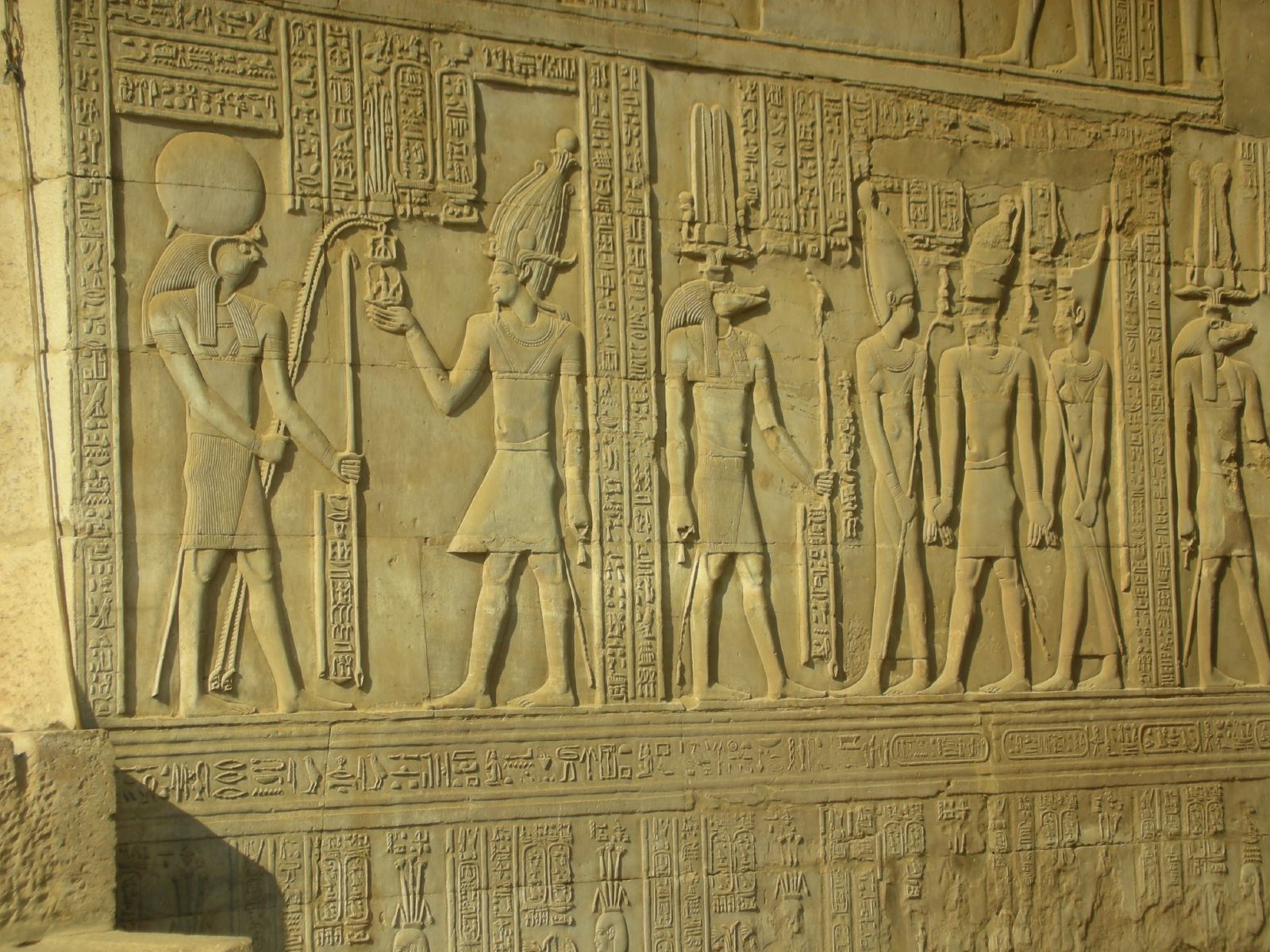
The ancient Egyptians achieved the miraculous in the decoration of their temples and monuments, sculpting hard stone into the softest, most delicate of forms in order to breathe life into the places where gods and kings would tread.  When I say "decoration", I must be careful not to evoke the concept of art for art's sake, or ornamentation strictly for aesthetic considerations; as these concepts did not exist in ancient Egypt.  What we call decoration of Egyptian temples and monuments was in fact carefully orchestrated magical composition, images whose purpose was to actively engage in the sacred work of maintaining creation and the cosmic order.  Art works in ancient Egypt were animate creations to their makers, part of a highly ordered program of ritual activities that comprised what academics call the cult of Egyptian religion.  Cult in ancient Egyptian religion is the entire corpus of sacred activities, ranging from ritual offerings and gestures to two and three-dimensional deity images.  It was the deity image or cult image that formed the backbone of the temple system in ancient Egypt(1).

Three-dimensional cult statues made of solid gold and inlaid with lapis lazuli and other costly stones were maintained in every temple complex in Egypt, and these were the focal point of the elaborate rituals of the daily cult.  However, such images were only one type of deity image to be housed in the sacred precincts.  Still to be seen today in temples throughout Egypt, though far from the brightly painted glory of their heydays, are the astonishing range of both low and high relief carvings that covered literally every inch of these sanctuaries.  The Egyptians specialized in bas-relief, the very laborious and time-consuming technique of cutting down all the background stone of an image in order to leave it raised up slightly from the surface.  Such sculptural details were used throughout Egyptian temples to highlight important ritual images of the king as high priest performing the activities of the temple cult.


Ptolemy VIII relief, Temple of Kom Ombo, Egypt


Images of the Gods, too, were central to the elaborately sculpted and painted bas-relief programs added to magically awaken Egyptian temples, and there is plenty of evidence to show that certain of these images became focal points for cults of their own(2).  The most hallowed interior spaces of Egyptian temples were accessible only to special classes of the priesthood, however, the outermost walls of temples were places where common Egyptians could congregate in order to approach the Gods through special images carved into the stone surfaces of the temple(3).  Archaeological evidence amply supports the existence of sacred spaces for public and/ or semi-private prayer and worship that existed on the outer, public walls of Egyptian temples.  These existed in the form of relief images that were regarded as especially sacred, and were sheltered by cloth enclosures suspended from wooden dowels fitted into holes drilled into the stone around the images(4).  Some such images were even inlaid with colored and highly reflective materials in order to highlight their sacredness. Such spaces provided a semi-private means for ordinary Egyptians to give their personal petitions to the Gods.

My own work as a Kemetic iconographer strives to build a bridge between traditional and ancient avenues for worshiping the netjeru (Gods), and contemporary needs and considerations.  We no longer have the vast resources of a state-supported religious system to maintain our temple traditions, and the temples themselves have radically changed in stature.  We are groups of devotees here and there, many on the Internet, doing our very best with often considerably limited means, to carry on a millenniums-old tradition of honoring Egypt's original deities.  My strongest means of accomplishing this is through the revival of the cult image as a means for establishing an authentic energetic link with the netjeru, which forms a foundation for the practice of the daily cult.

I am obviously not working in stone, thus true bas-reliefs are not my medium.  However, I have developed my own technique for continuing the time-honored use of raised relief surfaces for sacred images of the netjeru.  Using gesso in a liquid form, I carefully build up especially significant details of my icons into 'bas-reliefs', which are then gilded with 22 karat gold.  Crowns, jewelry, hieroglyphs, and certain parts of a deity's anatomy are prime candidates for gilt relief treatment in my icons.  These portions of the icon will then stand out considerably in the shrine and ritual environment, where they will be viewed primarily by candle light.  Real gold has always been used for icons in many iconographic traditions around the world, and this because gold is not only a precious commodity, but also because of its luster when exposed to direct or indirect lighting.  This effect is significantly heightened when the thinest leaves of gold are layered over a finely detailed relief surface.


A scene from the miniature shrine found in the tomb of Tutankhamun depicting the young king with his queen Ankhesenamun

A similar effect was achieved by the artisans who crafted the miniature gold-covered shrine found in the 18th Dynasty tomb of Tutankhamun.  In this instance, craftsmen used a linen-covered plaster base in order to produce very delicate raised reliefs, which were covered in thick sheets of gold foil that were then exquisitely chased(5).  My technique may be somewhat different, but it is completely in keeping with the spirit of such ancient works recovered from the tomb of Tutankhamun.  Instead of working my details into thick sheets of gold foil, my technique uses a liquid gesso to create raised and intricately detailed surfaces to receive the thinest and finest gold leaf available.

Notes 

1) 
Teeter, Emily.  Religion and Ritual in Ancient Egypt.  New York, NY, 2011, pp. 41-46.
2)  Ibid, pp. 78-83.
3)  Ibid, pp. 83.
4)  Ibid, pp. 78.
5)  Reeves, Nicholas.  The Complete Tutankhamun: The King, the Tomb, the Royal Treasure.  New York, NY, 1990, pp. 140-141. 

I now present a collection of photographs of my icon panel of "Hwt-Her Mistress of the Sky", which show the completed gesso reliefs prior to sealing with shellac and gilding.